








A 27000mAh power bank may fall within a common airline energy limit, but the capacity in milliamp-hours alone cannot establish permission to fly. Check the watt-hour rating printed on the exact unit, the battery’s condition and the operating airline’s current rules. Power banks belong in permitted carry-on baggage, with additional restrictions that can depend on the airline, route and energy rating.
Read watt-hours before relying on capacity
Milliamp-hours describe charge at a reference voltage. Watt-hours describe energy. When the manufacturer provides the relevant nominal battery voltage, the calculation is watt-hours equals milliamp-hours divided by 1000, multiplied by that voltage. For illustration, 27000mAh at 3.7V corresponds to 99.9Wh, while 27000mAh at 3.85V corresponds to 103.95Wh. Those are calculation examples, not ratings assigned to a particular product.
Do not multiply a cell-capacity figure by the USB output voltage unless the manufacturer specifically defines the capacity at that voltage. A 5V output label and a cell-level mAh figure describe different parts of the system. Use the manufacturer’s marked Wh rating and supporting documentation. If the label is unreadable, missing or inconsistent, resolve the issue before travel rather than expecting airport staff to accept an informal calculation.
Understand the general United States passenger framework
The FAA PackSafe lithium battery guidance sets out the United States passenger framework. Lithium-ion spare batteries up to 100Wh are generally permitted under its stated conditions. Batteries above 100Wh and up to 160Wh require airline approval and are subject to quantity limits. Larger batteries generally do not qualify under the ordinary passenger allowance.
These limits do not override stricter operating-airline or route-specific requirements. Airlines can restrict the number, placement or use of power banks, and rules can change. Check the carrier actually operating each flight, including a connection booked through another airline. A previous successful trip is not evidence that the same arrangement will be accepted on the next journey.
Keep a power bank out of checked baggage
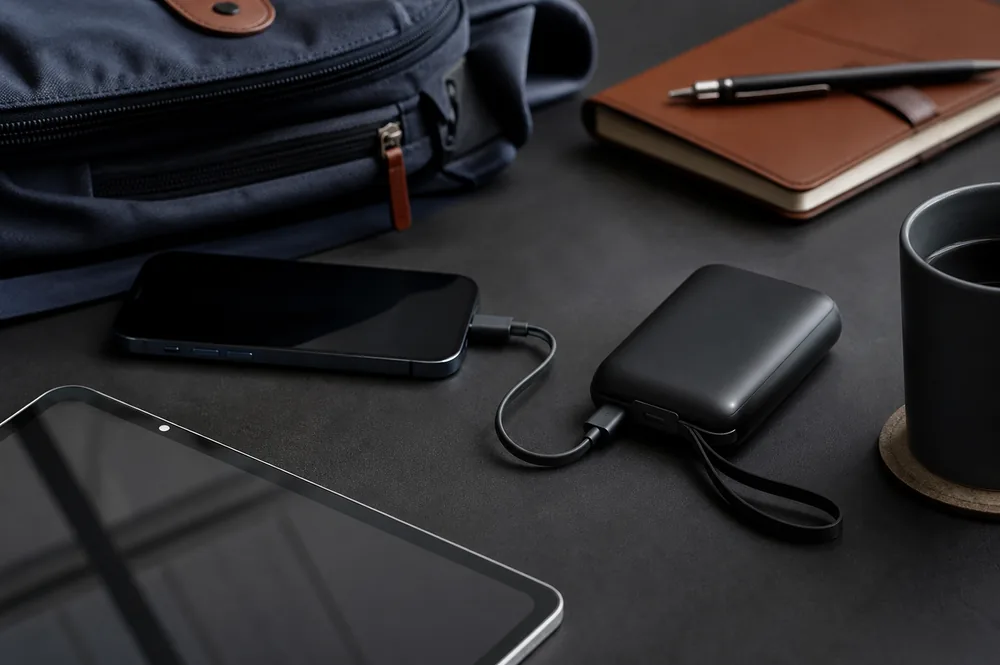
Power banks are treated as spare batteries, so pack permitted units in carry-on baggage. Protect them from damage and short circuits and keep them identifiable. Do not pack loose metal objects against exposed connections. A protective pouch can help with organization, but it does not make an oversized or damaged battery acceptable.
If your cabin bag is taken at the gate for loading into the hold, remove the power bank and other spare lithium batteries before handing over the bag. Tell staff what you are carrying if you are uncertain about the procedure. Follow the airline’s instructions on where the unit must remain accessible during the flight rather than assuming an overhead-bin location is always allowed.
Check condition as well as energy rating
Do not travel with a swollen, leaking, cracked, unusually hot or recalled power bank. A compliant capacity does not make a damaged lithium battery safe. Check the exact model against relevant recall information and follow any manufacturer’s safety notice. If damage is discovered at the airport, ask staff for instructions; do not conceal it or place it in an ordinary waste bin.
Inspect the housing, cable and ports before packing. Keep the unit protected from crushing and avoid accidental operation. If a device becomes hot, emits smoke or behaves abnormally on board, notify cabin crew immediately and follow their instructions. Do not improvise a repair or continue charging to see whether the fault clears.
Distinguish charging power from stored energy
A label such as 240W describes a power capability under specified operating conditions, not the amount of stored battery energy. It cannot establish an airline allowance. Conversely, a small USB output does not prove a low Wh rating. The guide to power bank capacity explains why these measurements need to be kept separate.
The PISEN BOLT 240W 27000mAh Power Bank TP-D106 is a catalog example whose exact Wh marking and current transport documentation must be checked. This article does not certify that model for every airline. Do not infer its cell voltage or permitted route solely from the product name.
Compare alternatives using their actual labels
A PISEN 30W Retractable Cable Power Bank 10000mAh TP-D239 may suit a different charging requirement, but it still needs the same label, condition and carrier checks. A PISEN Semi Mirror 22.5W 30000mAh Power Bank TP-D040 must likewise be assessed using its stated energy rating rather than being accepted or rejected by mAh alone.
Choose enough energy for your intended devices without assuming that carrying the largest available battery is best. Consider cable compatibility, the duration between charging opportunities and the carrier’s current quantity rules. Keep the model information available with your booking notes if airline approval is required.
Confirm onboard use before departure
Permission to carry a power bank does not necessarily include permission to use it or recharge it in flight. Check the airline’s policy on both activities. Charge devices beforehand when practical, using compatible equipment and a ventilated surface. Do not charge a power bank inside a closed bag or leave a suspect unit connected simply to finish preparing for the trip.
Use cargo guidance for a commercial shipment
Prepare a short travel check record before departure: the model printed on the unit, its Wh rating, the operating carriers and any approval reference. Keep the actual label visible rather than covering it with a pouch sticker or an accessory. If a website and the carrier’s direct answer appear inconsistent, ask the carrier to clarify which requirement applies to your route. Do not assume a customer-service answer for a different battery or itinerary covers yours.
Retailers answering travel questions should provide the exact product documentation and direct customers to their airline. They should not label every 27000mAh model “airline approved.” Any such claim needs a clear scope and current evidence; a capacity category is too broad to support it.
Shipping power banks to a customer is different from carrying one as a passenger. Consult the PHMSA lithium battery transport guidance and a qualified shipper for cargo requirements. For your own flight, the final checks remain the exact Wh label, safe condition, carry-on packing and the current operating-airline rules.